Winning requires all four at once
Most companies get one or two right. Then they wonder why nothing changes.
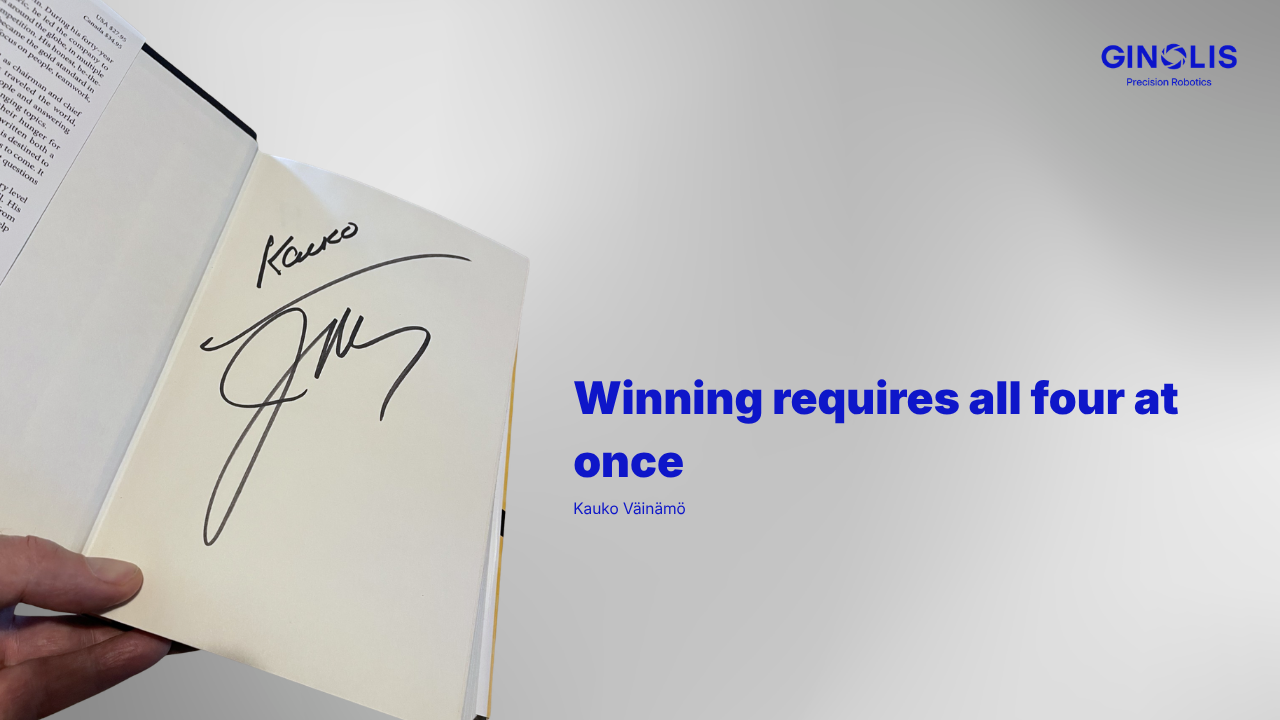
In May 2007, Jack Welch came to Finland for the first time. KPMG had arranged the event. I was in the audience. He was promoting his book "Winning," and I remember thinking: this should not work. An American business legend, famous for being blunt and loud, standing in front of a room full of Finns who value modesty, quiet competence, and consensus over confrontation.
On paper, a mismatch. In practice, the room leaned in.
Welch's argument was simple. Winning companies combine four things, and you need all of them at once. Brutal honesty. Clear direction. Disciplined people management. Relentless execution.
I have spent nearly twenty years since that evening testing whether he was right. Across turnarounds, company builds, a 125-person restructuring, and over a thousand sales conversations in 37 countries, I have not found a single exception.
The first thing Welch talked about was candor. The absolute necessity of saying what you actually think. In most organizations, people do not. People hedge in meetings. They soften the review so nobody feels bad. The bad idea survives another quarter. To Welch, this was not politeness. It was a tax on the entire company. Candor speeds up decisions, surfaces better ideas, and ends the polite fiction that slows everyone down.
Listening to him in Helsinki, I had to smile. We Finns like to think of ourselves as direct. And we are, compared to many cultures. But Welch was pushing for something more demanding: candor as a daily discipline, not just an occasional outburst of honesty.
I have seen what happens when candor is missing. I once took over a company where the previous leadership had avoided difficult conversations for years. The result was 125 people, four subsidiaries, and no clear picture of what was actually profitable. Nobody had said out loud what everyone already knew. That silence cost the company its future. I had to rebuild it from 25.
Candor without execution is just talking. Execution without direction is just being busy.
Clear direction came next. A mission, Welch said, has to tell people where the company is actually going and what it stands for, in language they can act on. Not a framed poster in the lobby. Not a paragraph the executive team wrote at an offsite and then forgot. Something concrete enough that an engineer in Tampere or a salesperson in Turku could use it to make a real decision on a Tuesday morning.
This is where most companies fail. They have a strategy document. They have slides. What they do not have is a direction that every person in the building can translate into their own work without asking permission. When I bought Ginolis in late 2023, the company had technology, people, and fifteen years of accumulated know-how. What it did not have was a thesis everyone could act on. Building that thesis and making it specific enough to guide every quotation and every engineering decision was the first real work.
Then Welch turned to the people. This is where the Finnish audience grew quietest.
He insisted that leaders owe their people honest, differentiated feedback. Know who your top performers are and make sure they feel valued. Tell the broad middle exactly what they need to do to move up. And be honest with those who simply are not a fit. Keeping someone in a job they are failing at is, in his words, the cruelest form of management.
In a country where conflict is usually avoided and feedback is often delivered between the lines, that message landed with some weight. It landed with me, too. I learned the hard way, through turnarounds where I had to make those calls myself, that avoiding honest people's decisions does not protect anyone. It just delays the pain and increases the cost.
Candor has to be structural, not personal. It is not about one brave person speaking up. It is about building a system where the truth reaches the decision maker before the deadline passes. At Ginolis, I walk the floor. I join the coffee breaks. That is not culture building. That is information architecture. If the CEO only hears what gets filtered through two layers of management, the CEO is operating blind.
Direction has to be specific enough to be wrong. If your strategy cannot be disproven by next quarter's results, it is not a strategy. It is a wish. When I set the target to double revenue from 3 million to 6 million in a single year, that was specific. Everyone in the company could measure their own work against it.
People's decisions have to happen on a timeline. I learned from a turnaround mentor in Finland: if someone has not sold in 18 months, they will not sell in the next 18 months. That is not harsh. That is observed reality. The longer you wait, the more damage accumulates on both sides.
Execution is a daily practice, not a quarterly review. Sales is a production line. 15 impacts per week. A cold call, a demo, a quotation. All count the same. The activity level is the only thing you can control. Everything else is a result.
A CEO who cannot do the work cannot lead the people who do it.
When these four break down, the cost is not abstract. In diagnostics manufacturing, a production ramp that takes 24 months instead of three means the market window closes. The patient waits. A sepsis test that could deliver a result in 30 minutes instead of 72 hours sits in a lab because nobody could get the manufacturing line to work at scale. The gap between a researcher's breakthrough and a patient's outcome is almost always an execution gap, not a technology gap.
I have seen this pattern in country after country, industry after industry. Good technology, no direction, and a room full of people who have not told each other the truth. And the product that should be saving lives is still stuck between the lab and the factory floor.
Take your company's current strategy and hand it to three people at different levels of the organization. Ask each of them, without preparation, to describe what the company is trying to accomplish and what they personally need to do this quarter to contribute. If all three give you the same answer, you have direction. If they do not, you have slides.
Welch left Helsinki that evening, and the audience went back to being Finnish. Quiet. Measured. Not given to slogans.
But the argument stayed. Winning is not about copying an American style or a Finnish style. It is about having the courage to be honest, the clarity to point in one direction, the discipline to take people seriously, and the stubbornness to actually deliver.
None of these four works alone. Candor without execution is noise. Execution without direction is a waste. People's decisions without honesty become politics. It is the combination that matters. All four. Every day.
That is still the bar. Almost twenty years later, I have not found a lower one that works.
Kauko Väinämö, CEO, Ginolis.