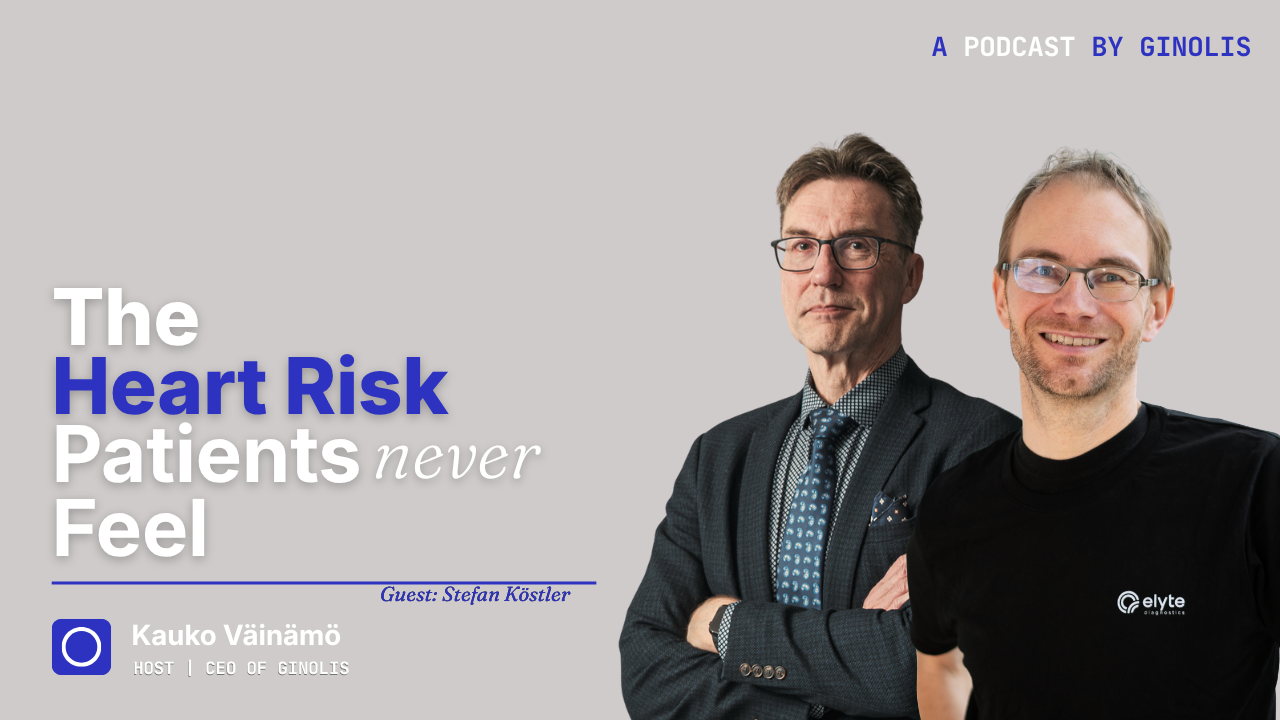
The Heart Risk Most Patients Never Feel, with Stefan Köstler
A number nobody can check often enough is holding back treatment.
I had a fascinating conversation with Dr. Stefan Köstler, CTO of Elyte Diagnostics, for episode three of The Builders of Modern Medicine. We talked about potassium, a number most people have never heard of and most patients never feel moved.
Potassium has to stay between 3.5 and 5.0 millimoles per liter in your blood. Go past that window in either direction and your heart rhythm is at risk, in the worst case cardiac arrest. Millions of heart failure and kidney disease patients live inside this narrow range. Today, most get it checked a few times a year through a lab draw.
I have spent years moving diagnostics from a lab bench to a production line that ships to 37 countries. Every time, the hardest part was building something a person with no training could use correctly, every single time, without a technician standing next to them.
Stefan's team is facing the same wall from the other direction. Strong clinical evidence backs the heart failure drugs that slow disease progression and extend life. Stefan told me that even the most effective of these, the fourth pillar therapy, is used to full guideline dose in under ten percent of eligible patients. Physicians hold back because they fear pushing potassium too high, with no practical way to catch it early, so they prescribe below what the evidence supports.
Glucose self-testing solved a version of this problem forty years ago and became a multi-billion-dollar market. Thomas Pieber, a diabetologist at Graz Medical University who later co-founded Elyte, watched that shift happen from the inside. He kept asking where else it could be repeated. Potassium, tied to heart rhythm and invisible until it is dangerous, was the field he landed on.
The engineering problem is different from glucose in one important way. Earlier attempts used ion-selective electrodes, the same sensing method used in hospital lab equipment, shrunk down for home use. Stefan said the results were accurate, but the workflow was not survivable outside a lab. Electrodes need calibration procedures that a patient at home will not reliably follow. Elyte moved to optical sensing instead, reading the sample with light rather than an electrical signal, which removes the calibration step entirely.
The benchmark they are building against is CLIA, the laboratory accuracy standard used in the United States for clinical potassium measurement. Stefan said their latest clinical studies are coming close to that standard, from a device meant for a kitchen table rather than a hospital lab.
Three decisions in how Stefan built this are worth naming.
First, he chose the sensing method for the person using it, not the lab that developed it. Optical sensing over electrodes was as much a workflow decision as a technical one.
Second, they ran usability studies with real patients at Graz University Hospital before finalizing the design. Stefan told me many of these patients already self-test for glucose and expect a new device to behave like the one they already trust. A small workflow mismatch against that expectation becomes a real barrier for the patient.
Third, they are already thinking about manufacturing at the prototype stage. Stefan has a background in contract manufacturing and injection molding, and he brings that into the lab from day one, even when it means compromising a prototype to keep the path to volume production open.
The gap between a handmade prototype and a million identical units is a design decision made too late, over and over, by teams that didn't think about the factory while they were still in the lab.
If Elyte reaches CLIA-level accuracy in a device a patient uses without help, the practical test is simple. A cardiologist has to trust the number enough to prescribe the full guideline dose instead of the cautious one. That single decision, repeated across millions of patients, is where the real impact of this work will show up, in a prescription pad rather than a press release.
Elyte is choosing Europe first for market entry, leaning on an existing clinician network and telemedicine partnerships already built around heart failure patients, before pursuing the larger and more unified US market in parallel. It is the same order most precision diagnostics companies get wrong: chasing scale before proving the workflow holds with the first hundred real users.
Kauko Väinämö
Kauko Väinämö is CEO of Ginolis, a precision automation company for microfluidics and diagnostics manufacturing based in Oulu, Finland, with over 150 production lines across 37 countries.